When You Stop Faking It: How Real Body Confidence Transforms Your On-Camera Game
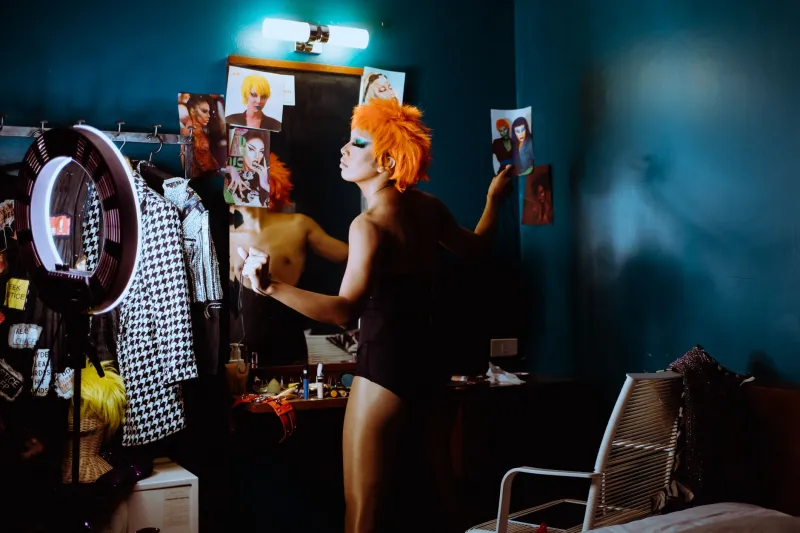
Let's be honest about something most industry guides won't say out loud: you can fake a lot of things on camera. Lighting, angles, moans — sure. But you cannot fake presence. Audiences feel it when a performer is genuinely in their body versus when they're mentally hovering somewhere above it, watching themselves through a critical lens and hoping nobody notices the discomfort.
For trans and non-binary performers especially, that internal critic can be loud. Society has spent decades telling us our bodies are wrong, incomplete, or somehow less-than. Carrying that noise into a professional shoot is like trying to dance with a backpack full of bricks. At some point, you have to put the bag down.
The Psychology Behind the Camera Shift
Sex-positive therapists who work with adult performers talk about something they call "embodied presence" — basically, the difference between being in your body and observing your body. When you're embodied, you're responsive, fluid, and magnetic. When you're in observer mode, you're stiff, self-monitoring, and honestly? It reads.
Dr. Simone Reyes, a licensed therapist in Los Angeles who specializes in gender identity and sex worker wellness, puts it plainly: "The performers I work with who struggle most on camera aren't struggling with technique — they're struggling with permission. Permission to take up space, to look the way they look, to feel pleasure without apology."
That permission isn't something a director gives you. It's not something a fan comment unlocks. It comes from inside, and building it is actual work — but the payoff is enormous.
What Performers Who've Done the Work Actually Say
Talk to any performer who's been in the industry for a few years and made it through that shift, and you'll hear a version of the same story. There was a before and an after.
Mia Solano, a trans performer based in Miami with a loyal fanbase of over 80,000 on her primary platform, describes her first two years of content creation as "technically fine but emotionally absent." She was hitting her marks, looking good by conventional standards, but something was flat.
"I was performing for this imaginary critical person," she says. "Some blend of every troll comment I'd ever read and whatever I thought a mainstream audience wanted from a trans girl. When I stopped making content for that person and started making it for myself — for my actual pleasure — everything changed. My engagement tripled within six months."
That's not a coincidence. Audiences — especially the kind of dedicated fans who become long-term subscribers and consistent tippers — are drawn to authenticity in a way that's almost primal. They can feel when someone is genuinely turned on versus performing turnedness-on. And they will pay significantly more for the real thing.
The Earnings Math Is Real
This isn't just about vibes. There's a tangible financial argument for doing the inner work.
Performers who report high levels of body acceptance consistently out-earn peers with similar follower counts who haven't made that shift. The mechanism is pretty straightforward: confident performers charge more (and don't apologize for it), retain subscribers longer, generate more repeat custom content requests, and build the kind of parasocial connection that translates to consistent income rather than viral spikes followed by dry spells.
When you're comfortable in your body, you also expand your creative range. You're willing to try new things, shoot in different styles, explore content that's more personal and therefore more valuable. Discomfort contracts your creative output. Confidence expands it.
Practical Steps Toward Actually Getting There
Okay, so how do you build this? Because "just love yourself" is the least useful advice in existence.
Start with solo content. Before you're performing for anyone, spend time creating content just for yourself — stuff you never intend to post. Get comfortable with how you look in motion, in different lighting, from angles you'd normally avoid. This is low-stakes exposure therapy, basically, and it works.
Audit your media diet. If your feed is full of content that makes you feel inadequate — whether that's mainstream beauty standards or even other performers whose bodies look nothing like yours — curate it aggressively. Follow creators who look like you and are thriving. Your brain needs visual evidence that your body is valid and desirable.
Work with a therapist if you can access one. This isn't about pathologizing your career — it's about having support while you dismantle years of internalized messaging. Many therapists now offer sliding scale rates, and some specifically serve adult performers and sex workers.
Talk to your community. Other trans performers have been where you are. The community around platforms like this one exists for a reason. Reach out, share honestly, and let other people's journeys inform yours.
Celebrate what your body does, not just how it looks. Pleasure is a function, not just an aesthetic. When you're focused on sensation and connection rather than appearance, something loosens. That looseness is what cameras love.
The Fan Connection That Follows
Here's the thing about fans that sometimes gets lost in the content-optimization conversation: they're not just consuming a product. The ones who stick around, who become your people, are looking for a genuine human being to connect with.
When you perform from a place of real confidence and real pleasure, you give them that. You become someone they feel like they actually know — someone whose enjoyment they can share in rather than just observe. That's not just emotionally satisfying. It's the foundation of a sustainable career.
The performers who last in this industry aren't always the ones with the most conventionally perfect bodies or the highest production budgets. They're the ones who made peace with themselves and brought that peace into their work. Every single time.
Your body — exactly as it is right now — is enough. More than enough. The camera doesn't need you to be anything other than genuinely, unapologetically present in it. And once you get there, everything else gets easier.